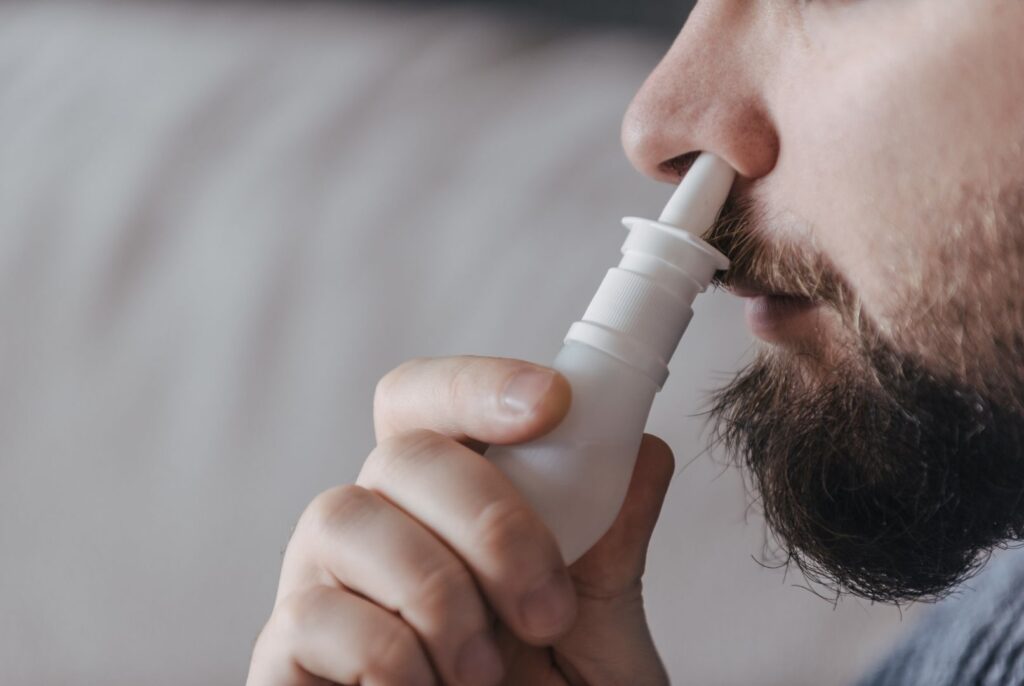
Written by Alex — I used nasal decongestant spray for 7 years before finally quitting. I’m not a doctor. Everything here is based on my personal experience and published medical research. Always consult a healthcare professional before making changes to your medication.
What Is Rhinitis Medicamentosa?
I want to start with something that took me an embarrassingly long time to understand.
For years, I thought my nose was the problem. I thought I just had genuinely bad sinuses, that I was one of those people who needed to use nasal spray to function. The spray wasn’t the issue — it was the solution.
I was wrong. The spray was the problem. And there’s a name for what I had: rhinitis medicamentosa.
The short version
Rhinitis medicamentosa (RM) is a condition caused by the overuse of decongestant nasal sprays — the kind containing oxymetazoline (Afrin, Dristan, Vicks Sinex) or xylometazoline. The more you use them, the more your nose needs them. The spray stops treating your congestion and starts causing it.
It’s sometimes called rebound congestion, drug-induced rhinitis, or — less formally — nasal spray addiction.
You’ve probably experienced it: you use the spray, get an hour or two of relief, then your nose blocks up worse than before. So you spray again. And again. And somewhere along the way, you stopped using it because you were sick and started using it just to feel normal.
That’s rhinitis medicamentosa.
What’s actually happening in your nose
Decongestant sprays work by constricting the blood vessels in your nasal passages, which reduces swelling and opens the airway. When they work, they work fast — that’s part of the appeal.
But here’s what the package insert doesn’t explain clearly enough. With repeated use, the blood vessels in your nasal lining become desensitized to the medication. They stop responding normally. When the drug wears off, they dilate more than they did before you started — causing worse congestion than your original problem.
This is called the rebound effect. It’s not subtle. It’s what wakes you up at 3am. It’s what makes you pull over on the highway to use the spray in your glove compartment.
Over time, inflammatory changes develop in the nasal mucosa itself. The lining of your nose changes structurally. That’s why long-term users often find that even when they try to stop, the congestion feels severe enough to cause panic.
Rhinitis Medicamentosa is more common than you think
A Swedish survey found that roughly 33% of the population experiences nasal congestion regularly, and 9.5% struggle with it daily. A significant portion of these people reach for over-the-counter decongestant sprays — and a meaningful number end up dependent on them.
According to data from US otorhinolaryngology practices, approximately 9% of ENT patients present with rhinitis medicamentosa (Feinberg & Feinberg, 1971). And that’s just the people who make it to a specialist. Many more are self-managing at home, quietly going through two or three bottles a month, not telling anyone.
I was one of those people for seven years..
It has all the hallmarks of addiction — and science is catching up
For a long time, the medical community debated whether this was „really“ an addiction. The argument was that nasal decongestants don’t produce a high. They don’t activate the brain’s reward circuitry the way classic addictive substances do. Therefore the dependency is „merely“ physical.
That distinction matters less than you might think when you’re sitting up at 3am unable to breathe.
More importantly, a 2025 peer-reviewed study published in the Journal of Behavioral Addictions examined 20 patients with rhinitis medicamentosa. Researchers found that all six components of Griffiths‘ addiction model were present in their experiences: salience, mood modification, tolerance, withdrawal, conflict, and relapse (Lakatos et al., 2025).
In plain language: people dependent on nasal spray displayed the same psychological and behavioral patterns seen in other recognized addictions.
What the participants said
Some of the quotes from that study stayed with me. One participant described their nasal spray as being as essential as their wallet or phone. Another described waking up with a blocked nose as „a near-death experience.“ Several reported having nightmares about suffocation. Many described shame, secrecy, and the specific humiliation of buying bottles at multiple pharmacies to avoid judgment.
These aren’t weak people. These are people caught in a physiological and psychological loop that’s genuinely difficult to escape.
I know, because I was one of those people. The bottle was always in my pocket — always, not sometimes — and I still kept a spare in my desk at work, one in my car, and one on my nightstand. I once drove back home twenty minutes into a road trip because I forgot to pack it.
I rotated pharmacies. Not because the prices were better — because I didn’t want anyone to remember my face.
The same study noted that participants had been using decongestant nasal sprays for an average of 15.3 years. The range was 2 to 40 years.
Let that sit for a moment.
Why it’s a taboo problem
One of the things that surprised me most when I finally started talking about this was how many people had the same experience — and how few of them had told anyone.
The Lakatos et al. (2025) study found that most participants treated their dependency as a taboo, keeping it hidden even from close family members. Some lied to pharmacists. Some described the shame of being „outed“ as a heavy nasal spray user. Unlike alcohol or other substance dependencies, rhinitis medicamentosa carries almost no social framework for understanding or recovery. There are no support groups. There’s no cultural script for it.
And yet the condition is real, it’s widespread, and it significantly impacts quality of life — affecting sleep, concentration, relationships, and even basic daily activities.
The habit loop behind the dependency
If you’ve read James Clear’s Atomic Habits, you’ll recognize the four-step cycle he describes: cue → craving → response → reward.
For nasal spray dependency, it looks like this:
Cue: Nasal congestion begins (or you anticipate it will)
Craving: The need to breathe freely — which feels urgent, even primal
Response: You use the spray
Reward: Immediate relief, the sensation of open airways
The problem is that the reward is real but temporary, and the response makes the original problem worse over time. Each cycle strengthens the habit while deepening the physiological dependency. Clear’s framework for breaking a bad habit — make the cue invisible, make the response difficult, make the reward unsatisfying — is genuinely applicable here, though it has to be adapted for the physical reality of withdrawal.
I’ll write more about this in a separate post on how to actually quit. But understanding the loop is step one.
Can rhinitis medicamentosa be treated?
Yes! The good news is that the nasal passages can recover.
The most commonly recommended medical approach is to switch from decongestant sprays to corticosteroid nasal sprays (such as fluticasone, sold over the counter as Flonase) during the withdrawal period. Corticosteroid sprays reduce inflammation without causing rebound congestion, which can make the transition more manageable.
I used fluticasone during my own withdrawal period and found it genuinely helpful for the first few weeks.
I want to be clear that I’m not a doctor and this isn’t medical advice — if you’ve been using decongestant sprays for a long time, talking to your GP or an ENT specialist before attempting to stop is worth doing. Some people benefit from a short course of oral corticosteroids in severe cases.
Beyond medication, the research and my own experience point to a few consistent principles:
Gradual reduction works better than cold turkey. This was crucial for me. Abrupt cessation causes severe rebound congestion. That’s the main reason people relapse. A step-down approach — stopping during the day first, then tackling nights — is more sustainable.
The psychological component is real. Several participants in the 2025 study reported that just thinking about not having their spray caused their nose to become congested (it is crazy, but true). Anxiety around breathing, hypervigilance to any sign of congestion — these need addressing alongside the physical withdrawal.
Movement helps more than you’d expect. Walking — particularly in cold air — noticeably improved my nasal breathing during the day. Exercise triggers vasoconstriction through the sympathetic nervous system, which temporarily reduces nasal swelling. It’s not a cure, but it takes the edge off.
Having a plan for the nights matters. A saline rinse, a humidifier, sleeping slightly elevated — small things that make a real difference when your nose is at its worst.
How long does it take to recover?
This varies, but the research and the experiences of people who’ve gone through it suggest a consistent pattern.
The worst of the rebound congestion typically peaks in the first 3–5 days after stopping. By around day 7–10, most people notice meaningful improvement. By week 5–6, breathing through the nose during the day becomes significantly easier. Full recovery of normal nasal function can take 16-21 weeks, though for people with very long-term dependency, it may take longer.
It sounds like a lot. And yes, the first few days are uncomfortable. But here’s what I didn’t expect: within a few days of stopping the daytime use, I was already sleeping better. The bedtime spray started lasting longer — my nose stayed clear through more of the night. Within a week, it lasted until morning.
That alone changed everything. Better sleep meant more energy. More energy meant I actually wanted to finish what I’d started.
The key thing I needed to hear when I was in the middle of it: the discomfort is temporary. Your nasal passages can and do recover. The tissue heals.
A note on what this isn’t
Rhinitis medicamentosa is specifically caused by the overuse of decongestant sprays — those containing oxymetazoline, xylometazoline, or phenylephrine. It is not caused by:
- Saline (salt water) sprays — these are non-addictive and actually helpful during recovery
- Corticosteroid sprays (Flonase, Nasacort) — these do not cause rebound congestion and are safe for long-term use in most people
- Antihistamine nasal sprays — these work differently and don’t cause the same rebound effect
If you’re not sure which type of spray you’re using, check the active ingredient on the label. Oxymetazoline and xylometazoline are the main ones to look for.
If you’re reading this at 2am
I know what that’s like.
The spray is right there. It would take two seconds. And everything in your body is telling you that you can’t breathe without it.
Here’s what I’d say: you’re not weak. You’re not broken. You have a physiological and psychological dependency that developed quietly, over time, because a medication that was only supposed to be used for three days turned out to be much harder to put down than anyone warned you.
Rhinitis medicamentosa is real. It’s medically recognized. And people recover from it.
If you want to understand how, I’ve written about what actually worked for me on this page.
Sources
Lakatos, L., Koltai, B. G., Ferencz, V., Demetrovics, Z., & Rácz, J. (2025). Does nose spray addiction exist? A qualitative analysis of addiction components in rhinitis medicamentosa. Journal of Behavioral Addictions, 14(1), 548–560. https://doi.org/10.1556/2006.2024.00078
Feinberg, S. E., & Feinberg, S. M. (1971). [Rhinitis medicamentosa prevalence data, US ENT practices]. Referenced in Lakatos et al., 2025.
Clear, J. (2018). Atomic Habits: An Easy & Proven Way to Build Good Habits & Break Bad Ones. Avery. https://jamesclear.com/atomic-habits
Akerlund, A., Millqvist, E., Oberg, D., & Bende, M. (2006). Prevalence of nasal congestion in the population. Referenced in Lakatos et al., 2025.
Medical disclaimer: This article is for informational purposes only. I am not a doctor or medical professional. Please consult your physician or an ENT specialist before stopping or changing any nasal medication.
Napsat komentář